
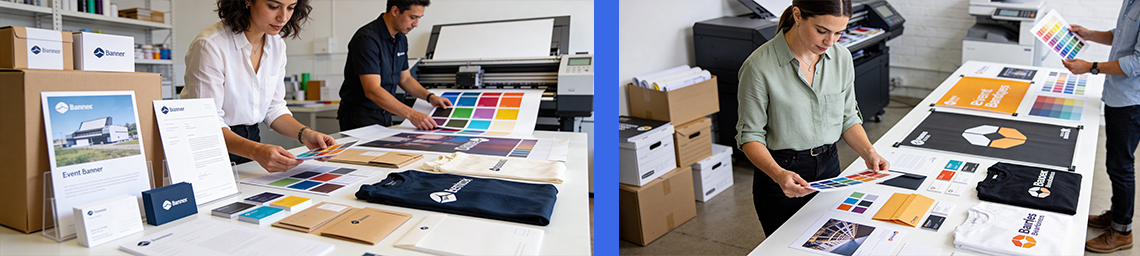
The print-on-demand products are presented as any other e-commerce products. It possesses products, prices, advertisements, and a checkout process. But most print-on-demand companies do not fail because of product weakness, but because their marketing presupposes that the customizable product is a constant SKU.
In print-on-demand, the product is not created in its entirety until the customer comes into play. That is the difference that changes the mode of establishing trust; hesitation has a way of creeping in, and the manner of perceiving marketing messages.
The typical consumer buying an ordinary t-shirt will consider size, color, and cost.
The risk is evaluated by the customer who buys an individual banner, business card, or invitation:
This is why the conventional e-commerce marketing playbooks do not work when applied to marketing print-on-demand products.
In this case, marketing is not only about creating awareness but also about reducing uncertainty.
This is in line with expectations of customers on personalization. A 2025 study by McKinsey concluded that 71% of consumers expect businesses to provide them with a personalized interaction, and 76% complain when the company fails to do so.
In the case of print-on-demand, this involves marketing more than just promoting customization; it has to exhibit clarity, control, and certainty of the result.
One of the greatest miscalculations in the path to selling print-on-demand products is treating them as ordinary e-commerce products. Products produced on demand cannot be purchased on impulse. They are bulky purchases from a decision-making perspective, as the customer is the one who produces the final output.
As an individual buys a tailor-made item, he or she does not examine the GSM, finish, and size initially. They are asking a deeper, more primeval question:
Nevertheless, in the majority of cases, print-on-demand marketing heads are based on specifications, not on results. This makes the customer perform mental calculations of feature-to-value, and most simply will not bother.
Through this, marketing should intervene.
Rather than Premium matte business cards, good messaging would be:
“Show up prepared, not generic.”
The biggest asset of print-on-demand is customization, but it is also its most significant impediment to conversion.
In realizing how to advertise your print-on-demand business, several sellers dwell on how to explain customization through text. As a matter of fact, explanations do not help to solve the customization anxiety. The eye certainty determines it.
The customers do not avoid personalization, but they do not know what their end product will look like. This hesitation is usually manifested as:
This is mostly prevalent with first-time purchasers and those who buy a print-on-demand beginner’s manual.
There is powerful visual evidence that alters this behavior. Print-on-demand is being effectively used in the following ways:
Pictorial evidence lowers the risk perception. It tells the customer:
“This is predictable. This is safe. You’re in control.”
The customers are attracted to print-on-demand because of personalization. But most companies inadvertently advertise it as being complex, delicate, or faulty.
You will find that you will often be messaged, such as:
Although such assertions might be operationally essential, they are sending the wrong message in marketing. They position personalization as something that the customer has to take a risk, and not something that he/she is sure to get the benefit of.
The fear should be eliminated actively through marketing.
Instead of making personalization seem something one does, make it look like something we make easily. The responsibility is handed over to reassurance:
Consumers hardly begin shopping for print-on-demand products on social media when they are willing to shop. They start with a search.
Queries like:
Such are not discovery searches. They are intent-driven. The user already has an idea of what he or she wants- he/she is choosing to trust someone.
That is why search content is so crucial in the way to market print-on-demand products.
Paid ads are beneficial to many POD businesses, whereas they lack serious investment in search-based content. The outcome is no long-term compounding returns, only short-term visibility.
Search marketing is particularly effective where print-on-demand is involved:
As per what Google has posted in the Think with Google, over 51% of buyers use search to research a purchase and then buy. This is even greater in the case of a print product where accuracy and timing are important.
Print-on-demand marketing involves effective search content to respond to actual buying questions, and not creating products. Pages that explain:
would be more attractive to users who are more conversion and price insensitive. This also justifies the explanation of print on demand that will lead to less friction in the funnel in the future.
One of the most overlooked parts of how to market print on demand products is education. Print products look simple, but for buyers, they often involve unfamiliar decisions—paper types, finishes, sizing, bleed, turnaround time, and customization limits.
When this information is missing or buried, customers hesitate. When it’s explained clearly, hesitation drops.
Most print-on-demand businesses assume customers already understand print. They don’t.
This is especially true for first-time buyers and small businesses following a print on demand beginners guide. They are not comparing printers based on technical accuracy; they are comparing based on how confident they feel while ordering.
Educational marketing bridges that gap.
This doesn’t mean long manuals or technical documentation. It means short, practical content that answers real questions:
Education reduces friction. Reduced friction increases conversion.
Social proof is effective in e-commerce, but not everything is helpful in the sphere of print-on-demand.
Most POD corporations are based on the generic reviews, such as Great quality or Fast delivery reviews. These are positive, but they do not discuss the actual issues that buyers have in mind when making a decision about personalized products.
The question that the customers would really want to know is:
This is where the majority of the print-on-demand questions silently appear, and where the correct type of customer demonstrations come into consideration.
Good evidence is use case oriented, rather than satisfaction oriented. Examples include:
As reflected in the statistics given by BrightLocal, 87% of consumers rely on online reviews as highly as they rely on personal recommendations. The trust is established more quickly in print-on-demand, where the reviews are not only opinions but also demonstrate results.
This is of particular concern when getting to know how to promote your print-on-demand business. Advertisements with tangible customer illustrations are more likely to work better than abstract brand promises because they will reduce doubt.
In print-on-demand advertising, there is hardly any occurrence of abandonment at the checkout. It occurs at a lower stage- during customization.
It is a very important distinction between POD and regular e-commerce, and it is widely misconstrued when individuals consider how to promote their print-on-demand company.
Customers may:
Analytically, this would appear as a lost visitor. The fact is that it is a high-intent user that should be reassured, rather than persuaded.
Classical retargeting is concerned with cart abandonment. Print-on-demand businesses have to take it a step further.
Retargeting tells customers not only what they have already watched, but effectively the point at which they had stopped watching it:
This is effective as the client has already spent time and mind. You are not beginning the conversation again; you are carrying it on.
In terms of print-on-demand processes, this is in line with buyer behavior. Personalisation is an obligation. That commitment should be honored in retargeting rather than forcing discounts off.
ions, effective POD email marketing supports the buying cycle:
Email marketing has been one of the most profitable ROI channels in ecommerce, but only when it reflects customer behaviour during purchase.
Purchasing is hardly real-time in print-on-demand. Customers pass through phases:
It is the perfect match of print-on-demand marketing as long as email is considered carefully.
Rather than normal promotions, the purchasing process is reinforced by efficient POD email marketing:
HubSpot research claims that email is always one of the most profitable marketing platforms, particularly for companies whose customers have a repeat purchase. Print-on-demand works very well in this profile when the personalization is stored and reusable.
Email can also be effective with print-on-demand items such as business cards, labels, and marketing materials, where the customer often revises and makes changes to existing information rather than having to completely redesign.
Paid advertising can help grow faster, but in print-on-demand marketing, it also helps to grow issues when the funnel is not clear. Most of the businesses enter the ads too soon, thinking that the traffic will solve the problem of conversion. As a matter of fact, advertising merely reveals the places of uncertainty that were already in existence.
This, in particular, applies when it comes to determining how to market your own print-on-demand business. The number of decision points in print-on-demand funnels exceeds what can be customized in typical e-commerce customization, preview, approval, and delivery expectations, all of which affect the next step of the customer.
When such factors are not well conveyed, then paid traffic increases indecision rather than sales.
The number of questions that your funnel has to answer without friction before scaling ads is three:
At least in case these answers are not clear, the ads cause clicks and not confidence.
This is the reason why effective print-on-demand marketing teams pilot a message prior to expanding expenditure.
When the funnel is transparent and foreseeable, paid advertising is more of a growth lever, not a diagnostic one.
Repeat demand is not the first-time sales; the biggest benefit of print-on-demand is. However, most companies sell POD items either as a one-time product, which does not offer a significant chance of long-term growth.
The majority of print products are usually re-orderable in nature:
Rather than emphasizing the acquisition process only, powerful marketing incorporates the reminders and follow-ups into the customer process. This includes:
Repeat marketing is best in a print-on-demand process where the customers do not require a fresh start. In the case of past designs that are saved and can be edited with ease, reordering becomes comfortable and not cumbersome.
Bain and Company has stated that a 5% retention increase will make a 95 percent profitability much better. This is magnified in the case of print-on-demand companies; repeat customers have less education and less to reassure them.
The marketing that takes into account the continuous needs of the customers, instead of taking each order as a single order, will lead to compounding returns in the long term.
One of the fastest ways to damage trust in print-on-demand marketing is to let marketing promises drift away from production reality.
Marketing teams often focus on what sounds attractive: fast turnaround, unlimited customization, instant ordering. Operations teams focus on what is actually achievable given capacity, file requirements, and production timelines. When these two worlds don’t align, customers feel the gap.
This matters deeply when deciding how to market print on demand products, because personalization already introduces uncertainty. Overpromising speed or flexibility may win clicks, but it also increases complaints, refunds, and negative reviews.
Effective POD marketing treats predictability as a competitive advantage.
Clear messaging around:
builds confidence rather than hesitation. Customers are far more forgiving of a slightly longer timeline than a missed expectation.
This is especially important for time-sensitive products like invitations, event signage, and promotional materials. In these cases, honesty converts better than urgency.
Marketing that reflects how the print on demand process actually works doesn’t reduce demand—it improves customer quality and long-term trust.
There is hardly anything that shows the operational weakness to be more visible than marketing success.
Most print-on-demand enterprises put a lot of money into advertisements, content, and promotion before making sure that their systems are capable of supporting higher volume. Small inefficiencies are multiplied when orders are spiking: file problems, reduced turnaround, and reactive customer support.
This is what makes the best cases of how to advertise your print-on-demand business by the most basic rule: you should start marketing only when you can predict fulfillment.
The print-on-demand is quite sensitive to it since each order is one of a kind. Volume does not merely augment workload, but variation. Marketing growth will not be rewarding but risky in the absence of automation and organization.
That does not imply waiting until perfect. It means knowing:
Marketing is most effective at increasing a consistent system. It puts a strain rather than growth when it surpasses operations.
This is because in businesses operating on a print-on-demand basis, the early traction is usually whether the business gains momentum or burns out.
Channels and campaigns are not the only requirements of successful print-on-demand marketing. It is pegged on whether the system behind the store is able to fulfil the marketing promises.
Store2Print will be structured to promote this alignment between marketing and operations by facilitating:
Store2Print enables marketing efforts to scale above an organized and predictable system, as opposed to forcing marketing to cover the operational gaps, which will be covered anyway. This renders growth more sustainable for print service providers, as well as less tense.
Print-on-demand marketing is a traffic issue that is frequently pursued. It is actually an issue of trust.
When there is a feeling of confidence in the outcome, the customers will customize their products, invest time, and pay a premium. Marketing that creates less uncertainty will work well compared to marketing that attracts attention only.
Under the same conditions as the print on demand process, good marketing:
Print-on-demand is not a quick fix. It is a paradigm that favors clarity, discipline, and consistency. That is because when marketing is based on such qualities, it turns into a growth engine and not a risk.
See the full customization journey from customer design to production approval. Compare predictability, speed, and control before choosing your platform.
In order to sell print-on-demand products, it is necessary to pay attention to decreasing buyer uncertainty. Apply transparent previews, result-oriented messages, information, and realistic promises regarding delivery. It is marketing that builds confidence and not urgency.
High-intent search content combined with targeted ads and retargeting is the best method of advertising your print-on-demand business. Advertisements are most successful when the funnel outlines the personalization, preview, and turnaround time in a transparent manner.
Yes, print-on-demand for beginners is good when the expectations are not high. The products are of the template type, and well-defined work processes can assist new sellers to avoid operational paralysis as they gain customer trust.
Under e-commerce, product customization is done electronically, and the design is approved, and orders are entered into production at the point of checkout. This flow should be reflected in marketing in order to prevent the mismatch of expectations.
The most significant ones are how to deal with customization anxiety, to match marketing promises and production reality, and to scale traffic before it is ready to operate. The treatment of these early enhances conversion and retention.